


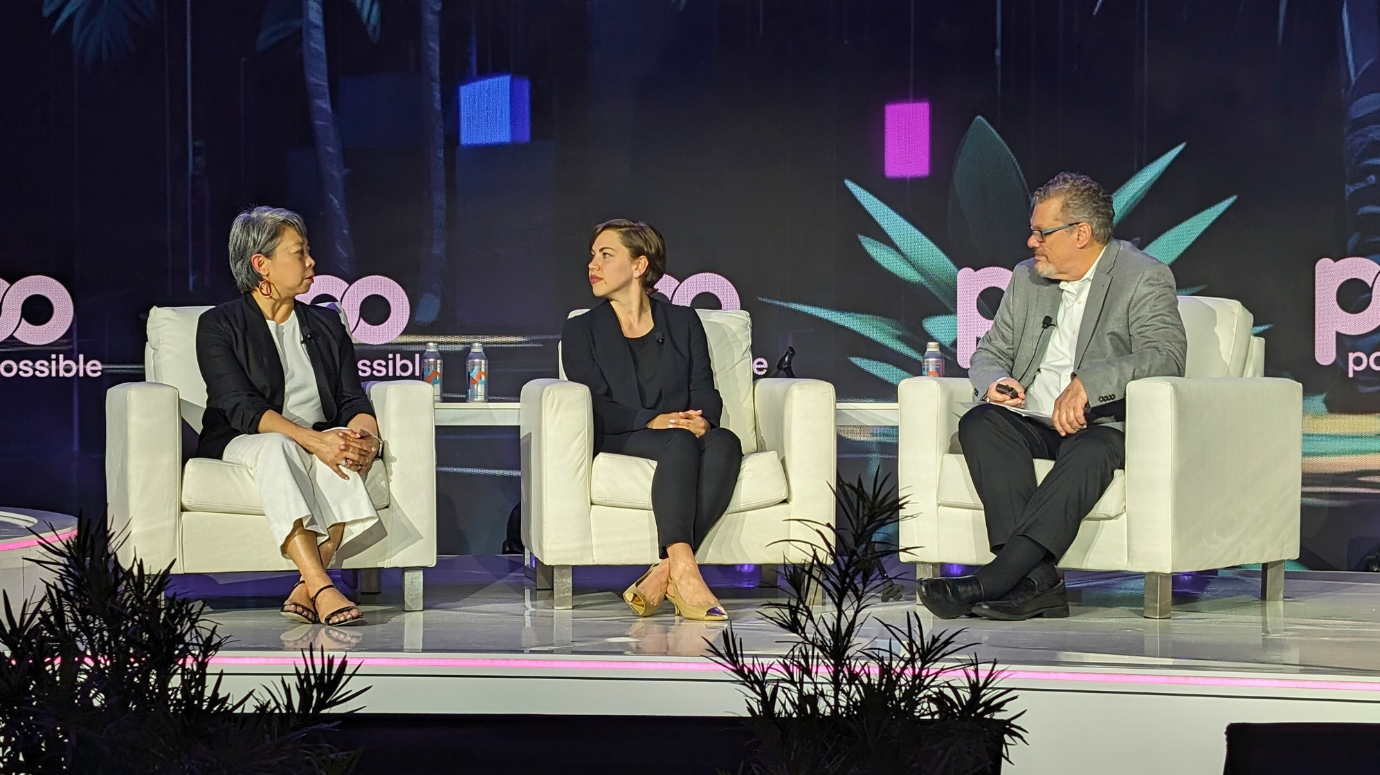
Tuesday at POSSIBLE 2024, the panel featuring Thomas Duncan from Kroger and Linda Lee from Campbell's Soup offered a reflective look at how major brands navigate the complexities of the "CMO+CFO misalignment" on the ROI of brand.
The session addressed strategies for leveraging consumer data and innovative marketing to drive value creation and customer loyalty. Vassilis Bakopoulos from MMA Global moderated the discussion, emphasizing the shift toward integrating brand and performance marketing.
Thomas Duncan, VP Head of Media, detailed how Kroger focuses on both customer acquisition and deepening loyalty through scientific and data-driven approaches. He highlighted that every marketing effort is essentially performance marketing, aiming to influence customer behavior whether through digital platforms or traditional media.
"It's all performance marketing; it's always been performance marketing," said Duncan. "There's a difference in the fidelity of the signal... but we were measuring it."
Linda Lee, CMO, shared insights on how Campbell's adapts to consumer needs, especially in challenging economic times. She pointed out the importance of providing value to customers, helping them stretch their dollars further through strategic product offerings.
"We believe we've got that portfolio to help consumers stretch their dollar, stretch their meals and in that value creation, how we bring that to life," said Lee.
Both panelists agreed on the necessity of aligning marketing strategies closely with business objectives, ensuring that every campaign contributes to overall corporate goals.
The panelists discussed several interesting outcomes and KPI's from their studies that were particularly noteworthy, including:
Customer Acquisition and Loyalty
Duncan emphasized that Kroger focuses on acquiring new customers and deepening loyalty with existing ones. The KPIs here involved measuring the frequency of customer visits and the diversity of categories from which they purchase. The goal was to scientifically drive customer engagement and increase store and digital platform visits.
Marketing Performance Mindset
Both Duncan and Linda Lee stressed the need to view all marketing as performance marketing, whether digital or traditional. Duncan noted that historically, even linear TV advertising was measured for sales impact and ROI, though with a longer feedback loop than digital advertising allows today.
Integration of Brand Value and Customer Experience
Duncan discussed how branding efforts at Kroger are deeply intertwined with performance metrics. The KPIs they focus on include customer acquisition, trial of new products or brands, and the direct financial benefits of branding activities.
Economic Response to Marketing
Linda Lee highlighted how Campbell’s marketing strategies are tailored to address economic pressures affecting consumers, helping them "stretch their dollar." The effectiveness of these strategies is likely measured by changes in consumer purchase behavior in response to marketing campaigns tailored to economic conditions.
Long-term Impact of Marketing Campaigns
A significant outcome discussed was the long-term impact of marketing campaigns on consumer behavior and sales, which goes beyond the immediate post-campaign period. The panel discussed how for every dollar gained during a campaign, another dollar could be realized post-campaign due to sustained changes in consumer behavior.
Brand Favorability
The panelists shared insights on the impact of brand favorability on consumer behavior, noting that consumers who are favorable towards a brand are significantly more likely to convert. This was measured in terms of higher sales per household among those who viewed the brand favorably.
"We have to earn customers' trust every day... But then to see when we're doing that well that we can create favorability and favorability has a 5x impact down the road, I think is really exciting," said Duncan.
Overall Takeaways
The discussion was stuffed with insights. Frankly, it was the nerdiest session that I attended all week in terms of media measurement KPI's and strategies. Key takeaways for attendees included:
- The Convergence of Brand and Performance Marketing: Duncan and Lee emphasized that all marketing should drive performance, dismissing the traditional separation between brand and direct marketing.
- Data-Driven Customer Insights: Both Kroger and Campbell’s utilize consumer data to tailor marketing strategies that not only attract new customers but also enhance loyalty among existing ones.
- Adaptability in Economic Challenges: Lee discussed how Campbell's adjusts its marketing to provide real value to consumers affected by economic pressures, demonstrating how brands can remain relevant during tough times.
- Continuous Improvement and Innovation: The panel underscored the importance of continuously refining marketing approaches based on real-time data and feedback, ensuring that strategies remain aligned with consumer behaviors and preferences.
Movable Middles: A New Framework
The second of the pannel recaps brought together in this edition of ADLINGO was led by Joel Rubinson of Rubinson Partners, who explored the impact of the "Movable Middle" framework on advertising effectiveness, both short-term and long-term.
This framework, which segments consumers not by traditional demographics or buying behavior but by their likelihood to choose your brand during a purchase decision, provided fresh insights into consumer responsiveness to advertising.
"It's not based on heaviness of buying, it's not based on demographics, it's not based on attitudinal segmentation; it's based on segmenting people based on the probability that they will choose your brand given that they make a category purchase," said Rubinson.
During the session, Michelle Alfano from Ally Financial and Kay Vizon from The Kroger Co. shared their experiences and findings from applying this novel approach.
"It [the study] gave us a lot of credit for the strategies that we've been putting in place as we bring some of our execution in-house," said Alfano. "We're making the most efficient use of the dollars that we have."
They discussed several studies where targeting "Movable Middle" consumers led to significantly higher responsiveness to advertising—up to 23 times more than other segments. It's an astonishingly high lift that, frankly, I think needs more examination.
This approach was shown to not only boost immediate campaign performance but also to drive long-term customer acquisition.
The results of the framework become more powerful as it gets translated back into terms that the rest of the business can understand. Helping finance teams understand the value drivers of media is a key learning.
"A key learning for us was you gotta bring your finance partner along," said Vizon.
Kroger's Marketing Controller now has a seat at the marketing table, and he is involved in the process end-to-end.
"He's seeing the early readouts in the mid-campaign readouts and the final readout," said Vizon. "He's asking a lot of questions, and what he's helping us to do is to translate our various mediacentric terminology, which nobody else at Kroger understands, and translate it to terminologies that the organization can readily understand."
How the Framework Works
The "Movable Middles" framework is a new-ish approach to consumer segmentation that shifts away from traditional methods like demographic or attitudinal segmentation. Instead, it focuses on segmenting consumers based on the probability that they will choose a brand given that they make a category purchase.
Specifically, it targets individuals who have between a 20% to 80% probability of choosing a particular brand when they are in the market to buy—a segment identified as "Movable Middles."
- Probability-Based Segmentation: Consumers are segmented not by how often they buy or their demographic traits but by their likelihood to choose your brand during a purchase decision. This likelihood is quantified, and the focus is placed on those who are neither brand loyalists nor brand rejecters but are persuadable.
- Targeting the Persuadable: By focusing on this group, the framework posits that advertising dollars can be used more efficiently. These consumers are more likely to be influenced by marketing because their brand preferences are not yet solidified, unlike loyalists or staunch rejecters.
Results of the Framework
- Increased Responsiveness to Advertising: During the session, it was revealed that Movable Middles have shown a consistent pattern of being at least twice as responsive to advertising compared to other segments. In some cases, they have been up to 23 times more responsive.
- Operational Implementation by TransUnion: In a practical application, TransUnion re-analyzed survey data to identify demographic and life-stage groups with a high incidence of Movable Middles. They then used this to refine media plans, leading to significantly higher campaign productivity.
- Long-term Customer Acquisition: The strategy demonstrated not only immediate improvements in campaign response rates but also substantial long-term effects on customer acquisition. Over an 18-month tracking period, campaigns targeted at Movable Middles led to a notable increase in new customers, highlighting the enduring impact of focusing on this segment.
Implications and Strategic Takeaways
- Focus on Incremental Gains: By targeting the Movable Middles, brands can achieve more significant incremental gains since these consumers are at a tipping point in their brand preferences and can be swayed more readily than others.
- Enhanced Long-Term Value: The strategy provides not just short-term campaign lifts but also enhances the long-term value of marketing investments by continuously attracting new customers.
- Efficiency in Media Spending: The approach advocates for more precise media spending, targeting individuals more likely to be influenced, thus improving the overall efficiency of advertising budgets.


