


How can you tell if a technology has mass impact on the world? Meaning virtually everyone with access is guaranteed to use it? Examples are all around us.
Think about how the BlackBerry played out
I had the 7200 series and then the BlackBerry Curve. I still miss the 7200 click wheel. How about you?
BlackBerry had genuinely excellent devices. They gave us email in our pockets, calendar sync, phone...the whole thing. It was loved by our fellow white-collar workers loved them everywhere.
At the same time, BlackBerry couldn't meaningfully cross over into the consumer mainstream. There are all sorts of reasons why they chose that path. I'm sure your Harvard MBA friend could explain. But clearly, BlackBerry stayed a work tool.
When Apple put its head down and got in the game, they upended the entire market. They built something that could plan your commute, play your music, take good pictures, browse the real web, and handle your email.
BlackBerry lost harrrrrrrd.
The idea of a robust mobile app store is an unbelievably genius move that only a company that built the largest digital music store could ever foresee.
I was working at CBS Broadcasting at the time, and we were not allowed to have iPhones due to "security concerns." As the digital content production (nerd) guy, I was unbelievably jealous of everyone that got to transition off BlackBerry. I'll just say this...Microsoft fanboys in the IT department ruin everything.
The iPhone delivered a better device and showed people what a computer in their hand could actually do. That knowledge naturally bled into their work. App ecosystems exploded because millions of people suddenly understood how awesome it was.
The same thing is happening with agents, as you read this.
The professionals who get ahead of this technology are going to be the ones who start at home.
AI came out of the gate as a (mainly) commercial application. Enterprise software, developer tooling, and stuff that required technical fluency just to get started.
The average consumer wasn't going to adopt it as it originally was.
That makes sense, honestly. Agentic tools are often headless. They have no real tangible interface. At most, you got a white web page with a plain open text box.
That is changing quickly.
For one thing, Google kept the familiar search box we've known for decades and replaced the outputs with AI-generated SERPs. As a result, searchers have been using AI extensively without realizing it.
Meta put a button for Muse in the header of Instagram. They didn't bury it in the settings. The header.
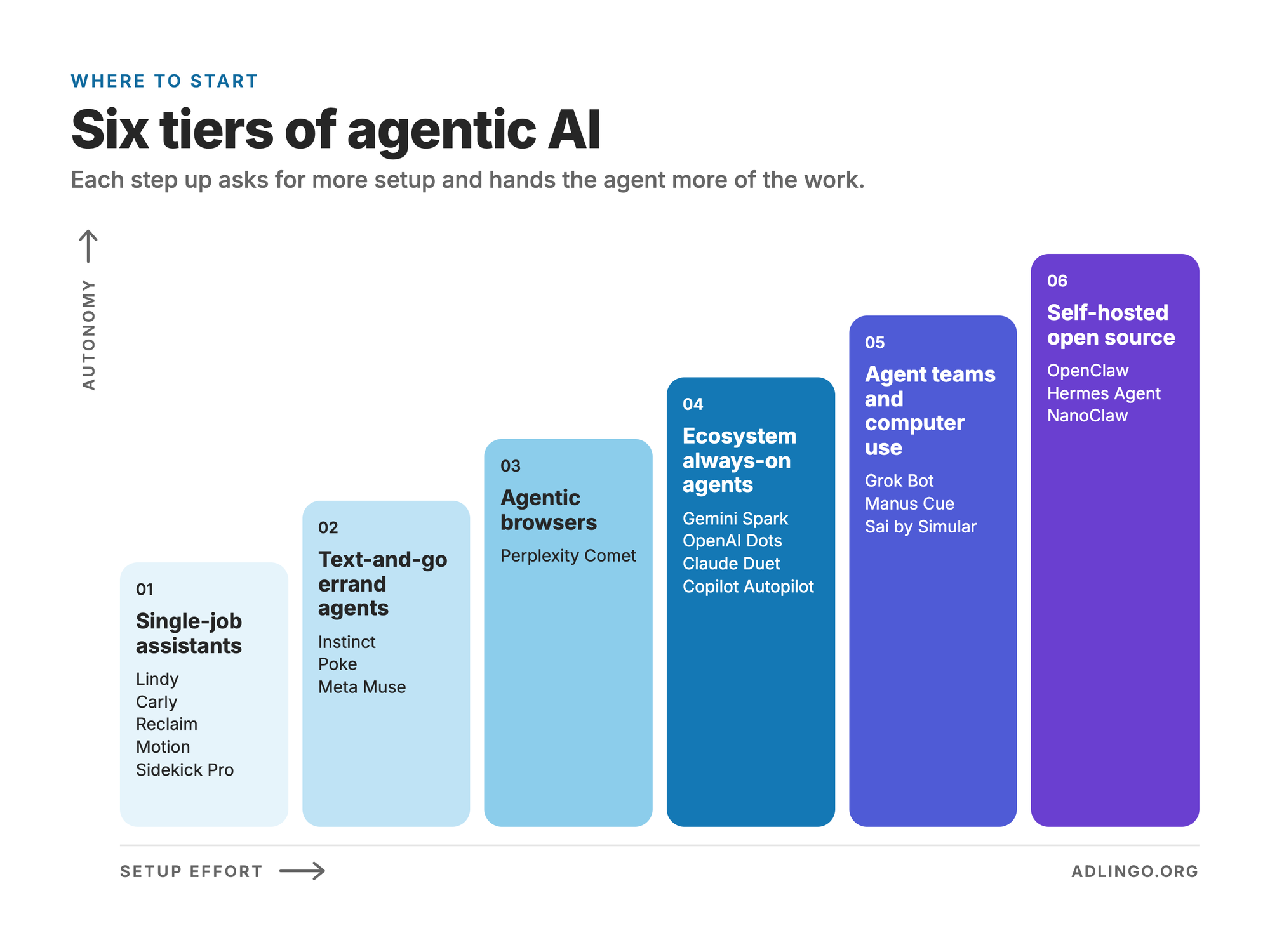
- Muse runs through WhatsApp and is free for US adults.
- Poke works over iMessage and SMS, requires no app download, and messages you first.
- Instinct books and rebooks your travel entirely through text, and it raised a billion dollars at a ten billion dollar valuation in September.
Those are mass-market interfaces. "Dumb simple" is the design spec. Two minutes to start. Real value generated in the first 10 minutes.
So what?
Once you get an agentic tool (or set of them) that genuinely benefits your personal life, your professional eyes open wider. You start asking what else this thing can do. You start applying that kind of thinking to your calendar, your email, your vendor research, your campaign planning.
That is how every mass-market technology adoption played out.
Think about it. The internet didn't take over the office because IT departments deployed it. It took over because eventually people came to work already understanding what it could do.
We are at that inflection point with agentic AI right now.
Anyone who has not deployed these tools in their personal life in a meaningful way is squandering a once-in-a-career opportunity.
Here is where to start, organized roughly from easiest to most involved.
FREE FOR SUBSCRIBERS
Get the full list.
19 agentic tools. Six tiers. Pricing, access, and where each one runs. Subscribe free and the curated list below is yours.
Subscribe FreeAlready subscribed? Sign in


