


Updated: November 9, 2026
If you’ve been reading the trades, you have seen that the AI honeymoon is over for most marketers. The numbers recently reported by McKinsey showed that while 88% of companies have integrated AI into at least one business function, only 6% are seeing meaningful financial impact.
Read that again. Six percent.
Everyone bought the tools, and almost no one got results.
Why?
The average culprit
For marketers, where is the disconnect? The outputs feel…average.
Most LLM systems output the "average of what the model has slurped up from content on the open internet. The bias towards “generic” leaves a brand with a complete lack of distinctiveness.
However, it does not need to be that way. Deep integration into a brand’s specific guidelines, attitude, values, and vibe create an invisible thread that connects customer inputs and actions.
Today, most brands have their documented identity scattered across dozens of folders, buried in intranet wikis, customer persona Powerpoints, and email inboxes. All of that information is invisible to AI tools unless you take proactive action.
Among the 50+ brands I spoke with in 2025, the vast majority said they lack any sort of AI data governance and have no brand specific training datasets at their disposal.
Breathtaking iteration speed
We joked for the better part of a decade that it was “the year of mobile.” Then it was the era of Connected TV. With AI, we are now speaking in terms of quarters (if not weeks).
When the industry converged on Las Vegas last week for CES, every meeting in the Aria Sky Suites was: agentic, agentic, agentic.
- Agentic search
- Agentic commerce
- Agentic planning
- Agentic creative
- Agentic retail media
- Agentic discovery
- …on and on.
For example, content generation dominated the AI conversations in 2025, but 2026 will be the year of agentic commerce.
The Ad Context Protocol (AdCP) initiative will also creep into many more conversations than you’d expect given that the group only launched a few months ago.
Frankly, your brand will not be able to meaningfully participate in any of these conversations because the outputs of the tools you use will be…blah. That’s because you have no way to meaningfully inform and train the tools to act like your brand.
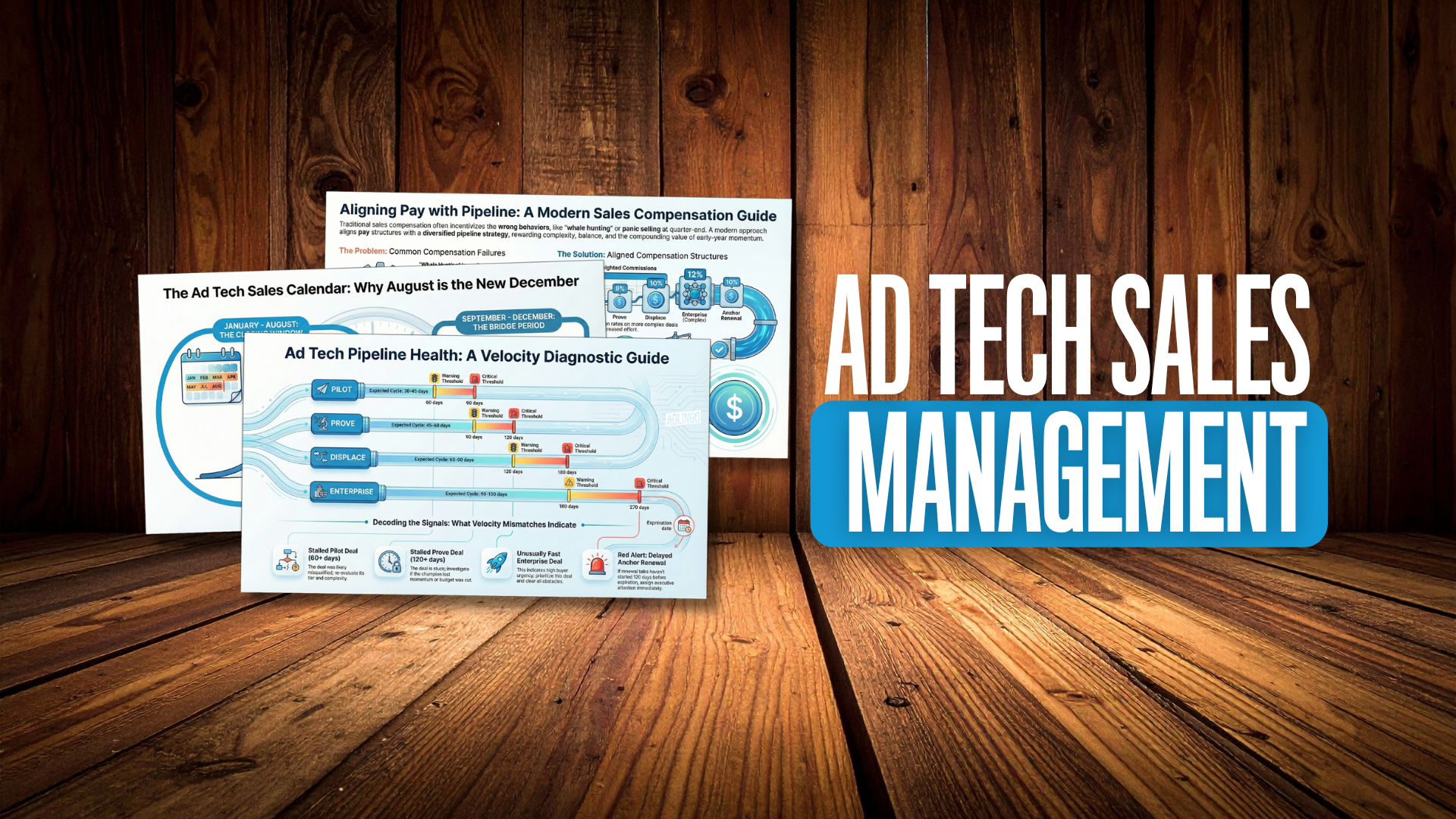
Fibonacci Velocity Framework
None of the most famous SaaS sales frameworks hit the mark when it comes to ad tech sales. I've been trained on dozens of them. They each have some great ideas, but nothing that pulls it all together. Until now. The FvF Framework is a mashup of the best sales frameworks for ad tech sellers.
The brand operating system
The concept of a “brand operating system” or BrandOS is both nothing new and mission critical for 2026. The term is not owned by any one provider that I’m aware of, but conceptually, the idea of a BrandOS puts the marketer in the correct frame of mind. How?
The most forward leaning CMO’s are building BrandOS with the express intention of operationalizing it through AI tools. It encompasses all of the brand codification “stuff” including tone, brand guidelines, legal requirements, and strategic intent transformed into a machine-readable format.
The architecture of these systems is not that complicated. The brand needs:
- A source-of-truth layer to house all of the structured brand data
- A governance layer that defines the rules for policy resolutions
- An integration layer that enables connection to various LLMs and external platforms. In short, a model context protocol (MCP) server.
The technical configuration can be quite simple to start. JSON files. YAML configs. Schema.org markup. The tools exist. The question is whether brands will assign resources internally to construct the BrandOS.
Once the asset exists, demand for it tends to gain momentum quickly. Every automation system your marketing team constructs internally or in partnership with external agencies will want access to the BrandOS asset. They will each want to embed it into the core layers of workflow.
Take search for example, which until now, was the most turnkey channel to activate for any brand. As of last year, visibility became semantic. The LLMs have gutted search traffic, with at least a 30%+ drop in click-through rates, then Gemini (and other tools) offer an AI overview to the user.
Now, there are emerging metrics like “citation score,” which amounts to how often your brand gets mentioned in AI-generated answers. Without a BrandOS powering the backend of all your brand’s digital presence systems, the brand is unlikely to show up. Or worse, answers about your brand might be hallucinated.
When you talk to CMOs, this is why they will all express that their job feels increasingly like a system integrator and infrastructure owner, and less like a classic brand architect. Quite simply, the role has completely changed and has no signs of turning back.
If you feel like your brand is in an AI adoption doom-loop where nothing is meaningfully taking hold, reframe the challenge. You do not have a technology problem, you just lack brand knowledge architecture.


