


ARTF (Agentic RTB Framework) and AdCP (Ad Context Protocol). Both promise to revolutionize how AI agents buy and sell ads, and both are pretty well backed by industry heavyweights.
Let's explore.
The Tl;dr version
ARTF is essentially focused on the programmatic plumbing. This standard is the IAB Tech Lab’s attempt to modernize how programmatic auctions work so that they can run faster inside the supply chain. SSPs, DSPs, exchanges, etc., all remain in the mix, but sloppy deployment of AI threatens to slow down the transaction speed. ARTF is, in theory, the fix. It standardizes more of the transaction language and puts more of the AI infrastructure closer to the endpoints.
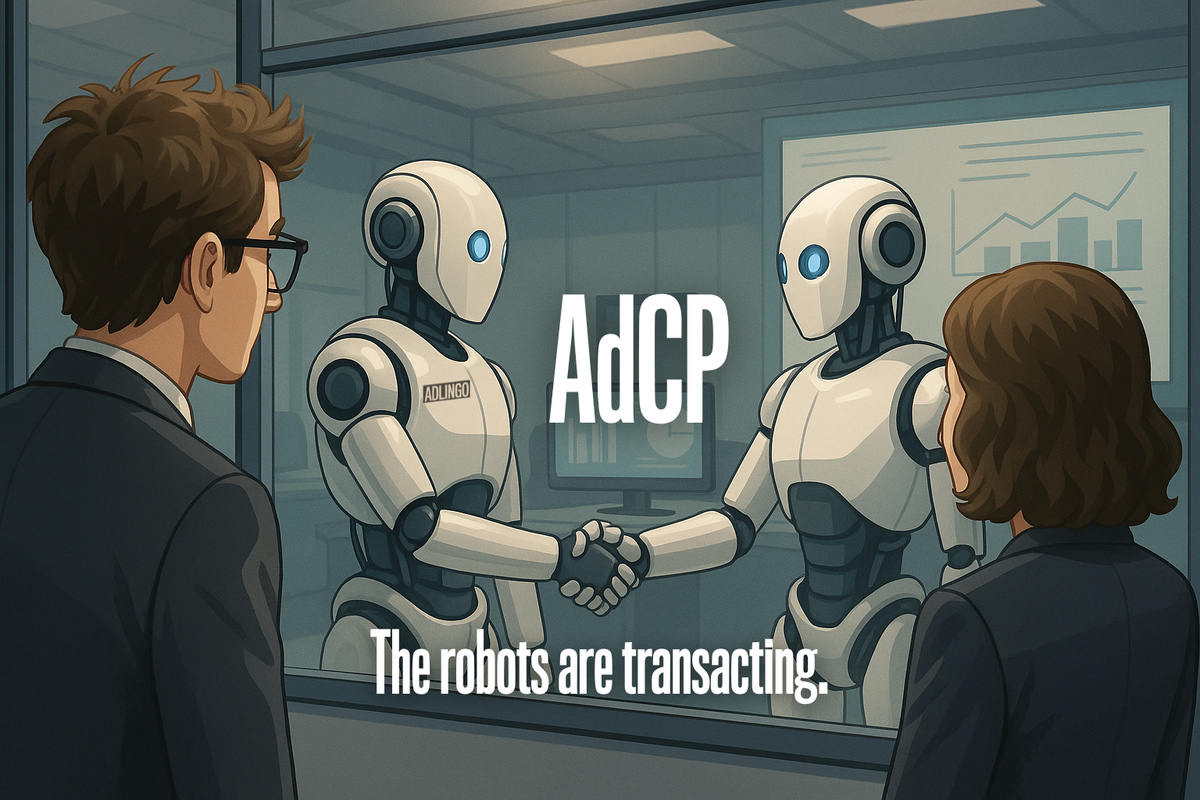
AdCP is intended to be the universal language that AI agents use to plan, buy, and measure campaigns on any platform. No need for custom integrations. The buyer and seller agents simply know how to “work it out themselves.”
|
|
Advertisers & Agencies |
Platforms & Infrastructure |
|
Workflow Layer |
AdCP for
Buyers |
AdCP for
Platforms |
|
Execution Layer |
ARTF Indirect
Benefits |
ARTF Auction
Runtime |
What ARTF actually does
The IAB Tech Lab launched ARTF to solve specific technical problems in programmatic auctions. These auctions are supposed to happen in milliseconds. What most people don’t know is that the transaction typically calls multiple external services mid-auction, hosted by DSP, SSP, and other supply chain vendors. This adds latency to the transaction.
Today, your DSP might call in dozens of vendors for each auction. Identify partners, fraud detection, contextual targeting, brand safety, etc. Each hop adds a few milliseconds.
The solution? Let AI agents run inside the auction infrastructure itself. Let these elements run within containerized environments hosted by the major players already involved in the demand and supply side of the transaction.
Who benefits the most? Host platforms like the SSPs and DSPs should love it because they get to maintain control while letting third-party services “plug in” to the transaction. Those other vendors should also love the structure because it allows them to package their tech payload once and deploy it everywhere.
Indirectly, advertisers should feel some of the goodness, too, because there will be fewer auction timeouts and better bid stream data availability.
ARTF is open for public comment until mid-January 2026. It already has the backing of WPP, The TradeDesk, Index Exchange, Netflix, and others.
From an advertiser’s POV, it might not be something to get that excited about just yet. The protocol aims to improve and streamline existing buying mechanics, not fundamentally upend how you buy or sell media.
But what about AdCP?
The question AdCP aims to solve sits at a much higher level and addresses a more existential question. Why do we need different teams, different processes, and different tools for every platform I advertise on? AdCP should allow AI agents to coordinate advertising workloads across any platform that supports the standard.
Imagine this: You as a human representing a brand tell your AI buying agent to go out and find “food destination travel enthusiasts with high discretionary travel behaviors,” compare prices of reaching those audiences across partners, then activate the best options to drive hotel bookings for your property.
Your buyer’s agent handles all of that for you.
The agents do all of the discovery across platforms, audience construction, campaign setup, creative adaptation, activation, and measurement. You, the human, approve the strategy, set the governance rules, and let it execute.
That’s the AdCP promise, anyway.
 Travis Lusk
What does AdCP standardize?
Buying
Planning and executing campaigns from intent to placement via natural language prompts
Creative
Generating and loading creatives that match platform specs across formats.
Signals
Activating first-party data and building segments portable across platforms.
Measurement
Coordinated reporting and optimization across the activated channels
Who’s backing AdCP?
An industry coalition including Ebiquity, Yahoo, PubMatic, Scope3, Trition Digital, Samba, Swivel, and many others.
The initiative is completely open source and available for anyone to browse on GitHub. That makes it interesting because instead of a top-down approach from a standards body issuing rules and guidance, a community of. Practitioners are building the infrastructure from the ground up.
Why do I think AdCP should matter more to Advertisers?
Your teams spend way too much time dealing with platform mechanics. Upwards of 70% of your team’s time is spent on logging into systems, searching for appropriate audiences, exporting findings, manually rebuilding plans, waiting for approvals, and repeating the process over and over again for each platform. It is job security for those who do it well, but also wildly inefficient.
When AI agents have the ability to handle most of this work, that frees up your teams to focus on strategy, governance, optimization, and insights.
AdCP also intends to have transparency baked in, including the ability to have audit trails. Open auditability is not something we have heard out of the ARTF group, yet.
How should you think about the two standards?
First, they are not in competition with one another. They’re actually complementary standards that can (should) exist side by side.
Think of it like this:
Brand intent → AdCP-speaking buyer agent → platform APIs → ARTF compatible host → containerized agents inside the auction.
AdCP handles the strategy and orchestration layer while ARTF sits at the ad execution and auction layer. One handles the “what to buy and where” question while the other handles the logistics efficiently.
|
Dimension |
ARTF (IAB
Tech Lab) |
AdCP (Ad
Context Protocol) |
|
Layer |
Auction plumbing / RTB runtime
– inside SSPs, DSPs, exchanges |
Workflow & orchestration
– above platforms, spanning APIs |
|
Unit of
standardization |
Container runtime + API for bidstream
mutation |
Task schemas + data models for planning,
buying, creative, signals, measurement |
|
Time scale |
Sub-millisecond, per-impression decisions |
Seconds–minutes–hours: campaign setup, optimization
loops, cross-platform orchestration |
|
Primary
domain |
Programmatic auction infrastructure |
Cross-platform advertising workflows
(open web + walled gardens where allowed) |
So what?
ARTF makes programmatic transactions work better while AdCP changes what’s possible.
Both matter. Both are very important. Both have a long way to go.
As I always say, today is the hardest it will be. Every week, groups of talented, highly dedicated people are grinding away at these challenges to the benefit of the rest of us.
Watch this space. Our industry will enjoy a major victory when the working groups figure out how to stitch AdCP-level orchestration into ARTF-level executions while ensuring total transparency.


